Compare The 2026 Subaru Forester Vs. Toyota RAV4: AWD, Safety, Space

2026 Subaru Forester vs. RAV4 at a Glance
- The Forester offers both gas-powered and hybrid models, while the RAV4 is now limited to hybrid powertrains.
- Symmetrical AWD is standard across the Forester lineup, while AWD is an available upgrade on the RAV4.
- Greater ground clearance, a higher maximum towing capacity,1,2 and a more capable outdoor-focused trim give the Forester an edge in off-road capability.
- Inside, the Forester Hybrid has 106.6 cubic feet of passenger volume versus 98.9 cubic feet in the RAV4, plus more max cargo space.
- JD Power gives the Forester a better reliability score than the RAV4,3 and the Forester has also earned an IIHS Top Safety Pick+ award.4
Subaru Forester vs. Toyota RAV4: More Than a Hybrid Showdown
Our Subaru Forester vs. Toyota RAV4 side-by-side reveals some significant changes for both SUVs. The Forester receives a complete exterior redesign, giving it a more rugged, boxy appearance than the previous model. The outdoor-focused Wilderness trim within the Forester lineup gains revised suspension, increased ground clearance, larger all-terrain tires, and other updates crafted for enhanced off-road performance.
The Toyota RAV4 also receives a redesign for 2026, but its biggest change is under the hood: the series is now exclusively hybrid, eliminating the gas-powered option altogether. But is limiting the powertrain lineup acceptable?
Beyond keeping its gas-powered option present instead of excluding a segment of drivers, the Forester has the upper hand in several key areas. For example, its standard AWD system, roomier interior, and award-winning safety features all give the Subaru an edge over the Toyota. Join Wallace Subaru of Bristol as we take a closer look at how these two compact crossover SUVs compare.
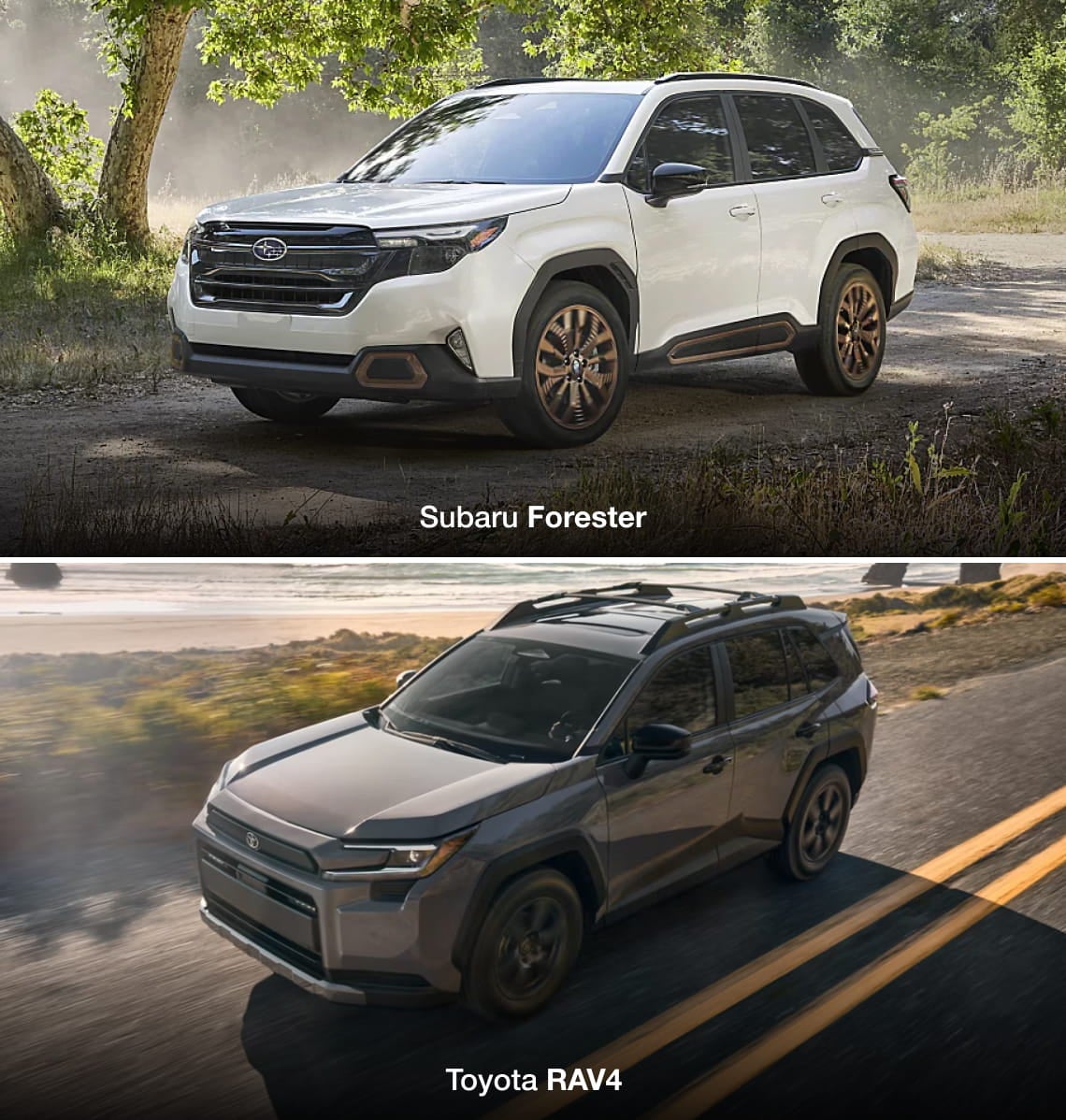
Subaru Forester vs. Toyota RAV4: Gas Choice or Hybrid Only?
The 2026 Subaru Forester has 10 trim levels to choose from with separate gas and hybrid setups, giving shoppers greater flexibility based on their priorities. The RAV4, by contrast, narrows the collection to six trim levels, all with hybrid powertrains.
Subaru Forester Gas & Hybrid Trim Levels
- Base
- Premium
- Premium Hybrid
- Sport
- Limited
- Wilderness
- Sport Hybrid
- Limited Hybrid
- Touring
- Touring Hybrid
Toyota RAV4 Trim Levels
- LE
- SE
- XLE Premium
- Woodland
- XSE
- Limited
| 2026 Subaru Forester | 2026 Toyota RAV4 | |
|---|---|---|
| Hybrid Option | Yes | Yes |
| Gas Option | Yes | No |
| Engine | 2.0L 4-cyl | 2.5L 4-cyl |
| Horsepower | 180 | 226 - 236 (net) |
| Transmission | CVT | 8-speed auto |
| Drivetrain | Symmetrical AWD | FWD / AWD |
| Max EPA-Est. MPG (Cty / Hwy / Comp) | 26 / 33 / 295 | 47 / 40 / 436 |
| Fuel Tank Size | 16.6 gal | 14.5 gal |
| Max Towing Capacity | 3,000 lbs1 | 1,500 lbs2 |
| JD Power Quality & Reliability Score | 81 / 100 (Great)3 | 71 / 100 (Average)3 |
| IIHS Testing Results | Top Safety Pick+ Award4 | Not Tested |
Want to focus specifically on hybrids? Check out our Subaru Forester Hybrid vs. RAV4 Hybrid review for a closer look at how the two electrified SUVs compare.
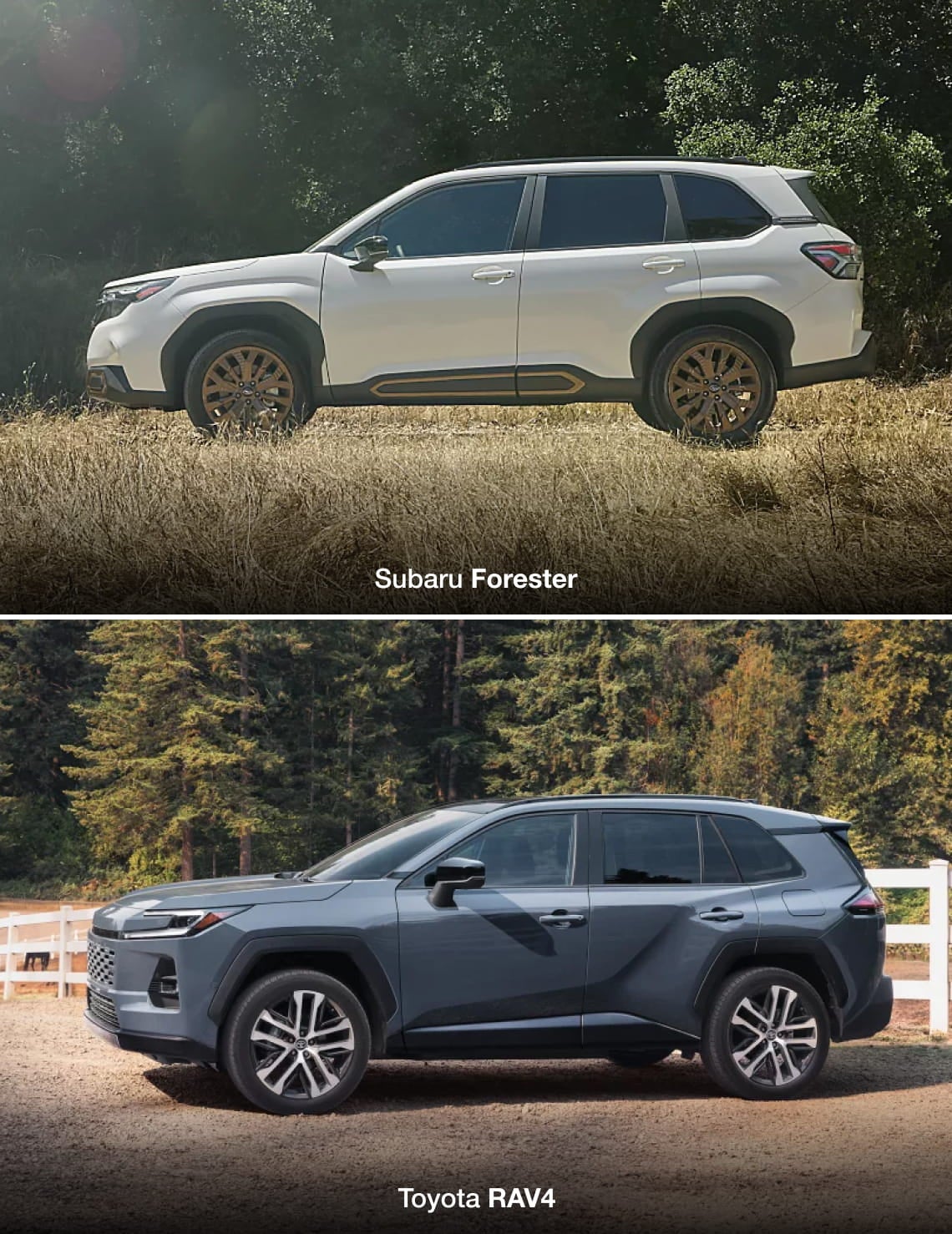
Forester vs. RAV4: AWD, Ground Clearance, & Outdoor Hardware
If capability is high on your list, the Forester starts with an advantage the RAV4 doesn't: every trim comes equipped with Symmetrical AWD. Subaru pairs its AWD system with X-MODE throughout the Forester series, giving you a traction-focused setup without having to upgrade. Toyota gives the RAV4 standard FWD and makes AWD available.
Once you leave the pavement, the Forester has a head start with 8.7 inches of standard ground clearance, compared with 8.1 inches on most 2026 RAV4 trims. The Forester Wilderness takes things a step further with 9.3 inches of clearance, dual-function X-MODE with Hill Descent Control, underbody protection, and Yokohama GEOLANDAR all-terrain tires.
The RAV4 Woodland is meant to be the answer to the Wilderness, but unfortunately, it falls short. Its 8.5 inches of ground clearance trails the Wilderness, and although standard all-terrain tires and Hill Start Assist Control provide some capability, they don't close the gap.
Towing is another clear difference. The Woodland is rated for up to 1,500 pounds,2 while the Forester Wilderness can tow up to 3,000 pounds.1
Add in the lower starting price of the Wilderness, and the Subaru has a pretty convincing case for your outings to Steele Creek Park or cruises along Flatwoods Road.
RAV4 vs. Forester: Interior Dimensions & Cargo
The Forester doesn't just give five people a place to sit; it gives them room to settle in. Each seat five, but the Subaru boasts 106 cubic feet of passenger space compared with just 98.9 cubic feet in the RAV4. The numbers continue to favor the Subaru, with the Forester offering greater front headroom, maximum rear headroom, and front and rear legroom.
Those spacious victories carry over to the storage area. Fold the second row down, and the Forester opens up 74.4 cubic feet of cargo space. The RAV4, again, comes up short with a max 69.8 cubic feet. Whether you're loading camping gear, luggage, groceries, or bulky weekend finds from Willow Creek Consign & Design Bristol, the Forester has room for it all.
| 2026 Subaru Forester | 2026 Toyota RAV4 | |
|---|---|---|
| Length | 182.9 - 183.3 in | 181 - 182 |
| Width | 72 - 72.4 in | 73 - 74 |
| Height | 68.1- 69.3 in | 66.7 - 67.1 in |
| Ground Clearance | 8.7 - 9.3 in | 8.1 - 8.5 in |
| Seating | 5 | 5 |
| Passenger Volume | 106.6 - 110.8 cu ft | 98.9 cu ft |
| Headroom (1st / 2nd Row) | 40 - 41.2 / 37.7 - 39.6 in | 37.9 / 39.5 in |
| Legroom (1st / 2nd Row) | 43.3 / 39.4 in | 41 / 37.8 in |
| Cargo Volume (Standard / Max) | 27.5 - 29.6 / 69.1 - 74.4 cu ft | 37.8 / 70.4 cu ft |
Subaru Forester vs. Toyota RAV4 Reliability & Safety Ratings
The Forester has another clear advantage over the RAV4 in safety and reliability. Both SUVs include comprehensive airbag systems and child-safety door locks, but Subaru goes a step further with whiplash-reducing front seats and height- and tilt-adjustable head restraints.
The difference becomes even more apparent when it comes to independent safety evaluations. The IIHS awarded the 2026 Forester Hybrid its prestigious Top Safety Pick+ designation,4 placing it among the year's highest-rated vehicles for crash protection. The 2026 RAV4 Hybrid had not yet been tested by the IIHS at the time of writing this.
The Forester also brings a stronger reliability score to the table. JD Power gives the 2026 Forester Hybrid an 81/100 Quality & Reliability score, earning a "Great" rating. The 2026 RAV4 trails behind at 77/100, which falls into the "Average" range.3
When you lease or finance a new Forester, you're getting a proven SUV backed by safety recognition and impressive reliability reviews.
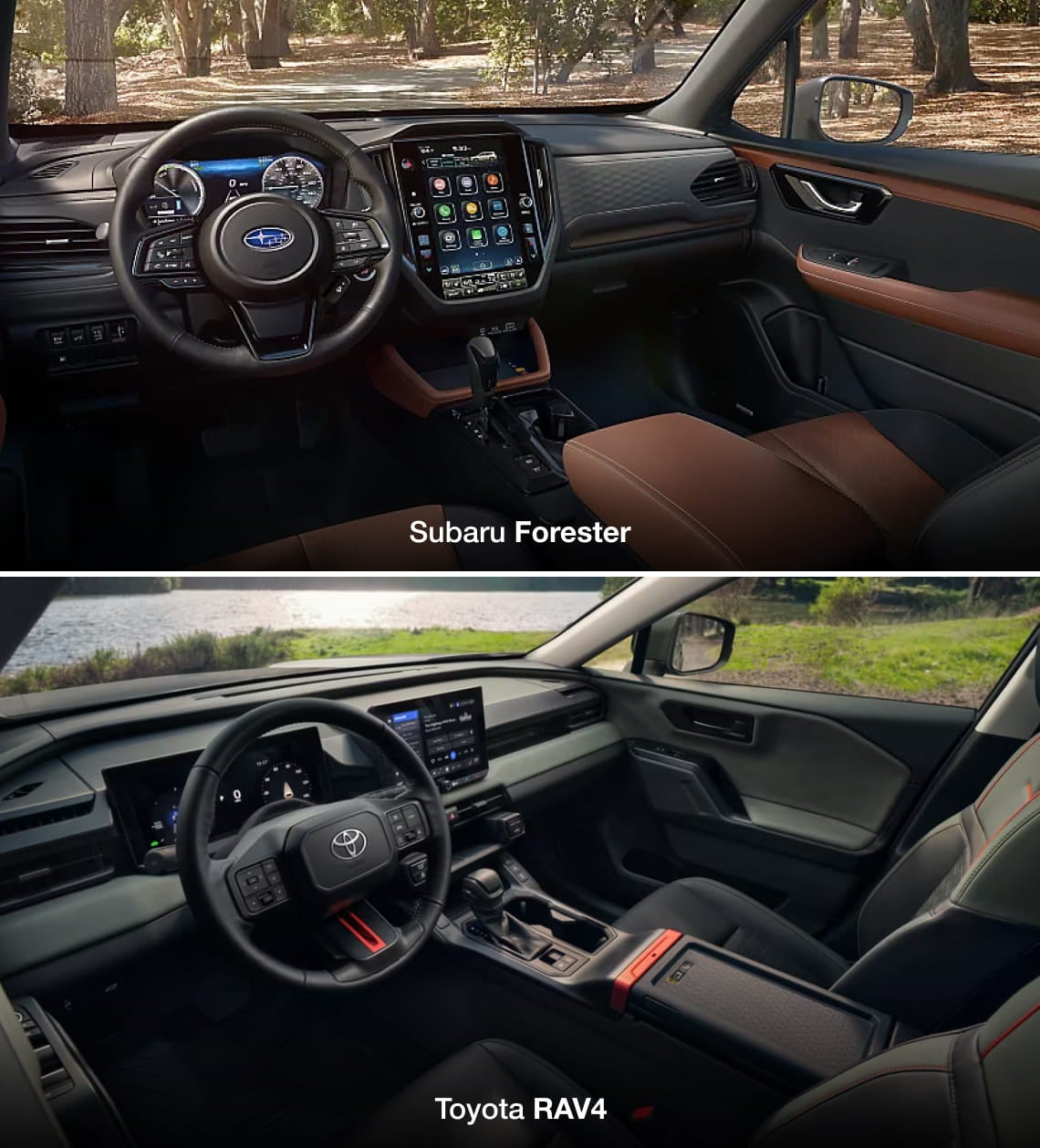
Subaru Forester or Toyota RAV4: Which One Is For You?
With standard Symmetrical AWD, greater passenger space, a capable trail-tuned trim, and stronger reliability marks, the Forester comes out ahead in our Subaru Forester vs. Toyota RAV4 matchup. But don't just take our word for it. Schedule a test drive at Wallace Subaru of Bristol and witness firsthand how the Forester could fit your drive.
See how the Forester stacks up against another popular rival in our Subaru Forester vs. Hyundai Tucson head-to-head.
Toyota RAV4 vs. Subaru Forester FAQs
Can you still get a Subaru Forester with a gas engine instead of a hybrid?
Yes, you can still get a 2026 Subaru Forester with a gas engine instead of a hybrid setup. Of the 10 available trim levels, six use a standard gas-powered 2.5-liter SUBARU BOXER engine. The other four pair that same engine with an electric motor and a 1.1-kWh lithium-ion battery pack for hybrid power.
How does all-wheel drive on the Subaru Forester differ from all-wheel drive on the Toyota RAV4?
The Subaru Forester uses full-time Symmetrical AWD as standard across the lineup, with a mechanically coupled system continuously managing power between the front and rear wheels. The Toyota RAV4 uses a front-wheel-drive-based system that brings the rear wheels into operation as needed. The Forester also integrates Symmetrical AWD with X-MODE, a component not found on the RAV4.
Which is safer, the Subaru Forester or the Toyota RAV4?
Both the Subaru Forester and Toyota RAV4 offer advanced safety suites, with EyeSight Driver Assist Technology on the Forester and Toyota Safety Sense on the RAV4. However, the Forester has the edge in current safety testing. The IIHS awarded the 2026 Forester Hybrid a Top Safety Pick+ accolade,4 while the 2026 RAV4 was still undergoing testing and had not received an IIHS award at the time of writing.
See Other Subaru Comparisons
1Maximum towing capacity varies by trim level. Trailer brakes may be needed. See your retailer for details.
2Before towing, confirm your vehicle and trailer are compatible, hooked up and loaded properly and that you have any necessary additional equipment. Do not exceed any Weight Ratings and follow all instructions in your Owner's Manual. The maximum you can tow depends on base curb weight plus the total weight of any cargo, occupants, and added vehicle equipment. "Added vehicle equipment" includes additional standard/optional equipment and accessories added by the manufacturer, dealers, and/or vehicle owners. The only way to be certain of your vehicle's exact curb weight is to weigh your vehicle without passengers or cargo. (Calculated with the new SAE J2807 method.) Installation of a tow hitch receiver or other accessories located near the rear bumper or side-door kick sensors may require disabling or removing the kick sensor, and the sensor operation setting in your vehicle should be turned off. See Owner's Manual for limitations.
3Reference to this third-party claim is solely for informational purposes and not to be relied upon. For details regarding this rating, visit https://www.jdpower.com/cars/
4Reference to this third-party claim is solely for informational purposes and not to be relied upon. For details regarding this award, visit https://www.iihs.org
5EPA fuel economy estimates. Actual mileage will vary with driving conditions and your vehicle's condition.
6Use for comparison purposes only. Your mileage will vary for many reasons, including your vehicle's condition and how/where you drive. See www.fueleconomy.gov.